Start here
The short answer
Liquid and slow-release products offer different ways to manage plant nutrition. Compare their actual labels, application method and existing fertilizer in the pot. Noot is measured into water, so its use belongs with an appropriate watering.
Physical form and nutrient release are different questions
Water-soluble fertilizers dissolve in water, while slow-release nutrients become available over time. Controlled-release products use coatings to regulate release, which is affected by conditions such as moisture and temperature. University of Florida Extension also notes that not every nutrient in an organic fertilizer is necessarily slow-release.
A liquid-looking product does not tell you everything about its nutrient forms. Read the formulation and directions rather than assuming that “liquid,” “organic” and “instant” mean the same thing.
Sources: University of Florida IFAS Extension
Compare the tasks you will actually do
A useful choice is one you can measure and record reliably. For a water-mixed product, you need to know the water volume and dose each time. For a product intended to remain in the mix, you need its application date, amount and stated release period. Neither format removes the need to check the plant before watering.
| Question | Water-mixed routine | Product left in the pot |
|---|---|---|
| What do I record? | Dilution, watering date and product. | Amount, application date and label duration. |
| What tool helps? | A marked container and measuring spoon. | The product’s specified measure and a plant tag. |
| What do I check before adding more? | Previous feed and any fertilizer in the mix. | Previous dose and whether the label period has ended. |
Look for a feeding program already in progress
Photograph the potting-mix label and ask the nursery about any granules already present. Do this before deciding to add a second product. A simple record is especially useful when several people care for the same collection: one person should not be guessing whether someone else already fed the plants.
When changing products, save both labels. Use their directions to plan the transition and ask the manufacturers about any unclear overlap. Do not invent a universal waiting period for all coated or slow-release products; the stated duration belongs to the specific formulation.
Choose Noot when a measured watering step fits
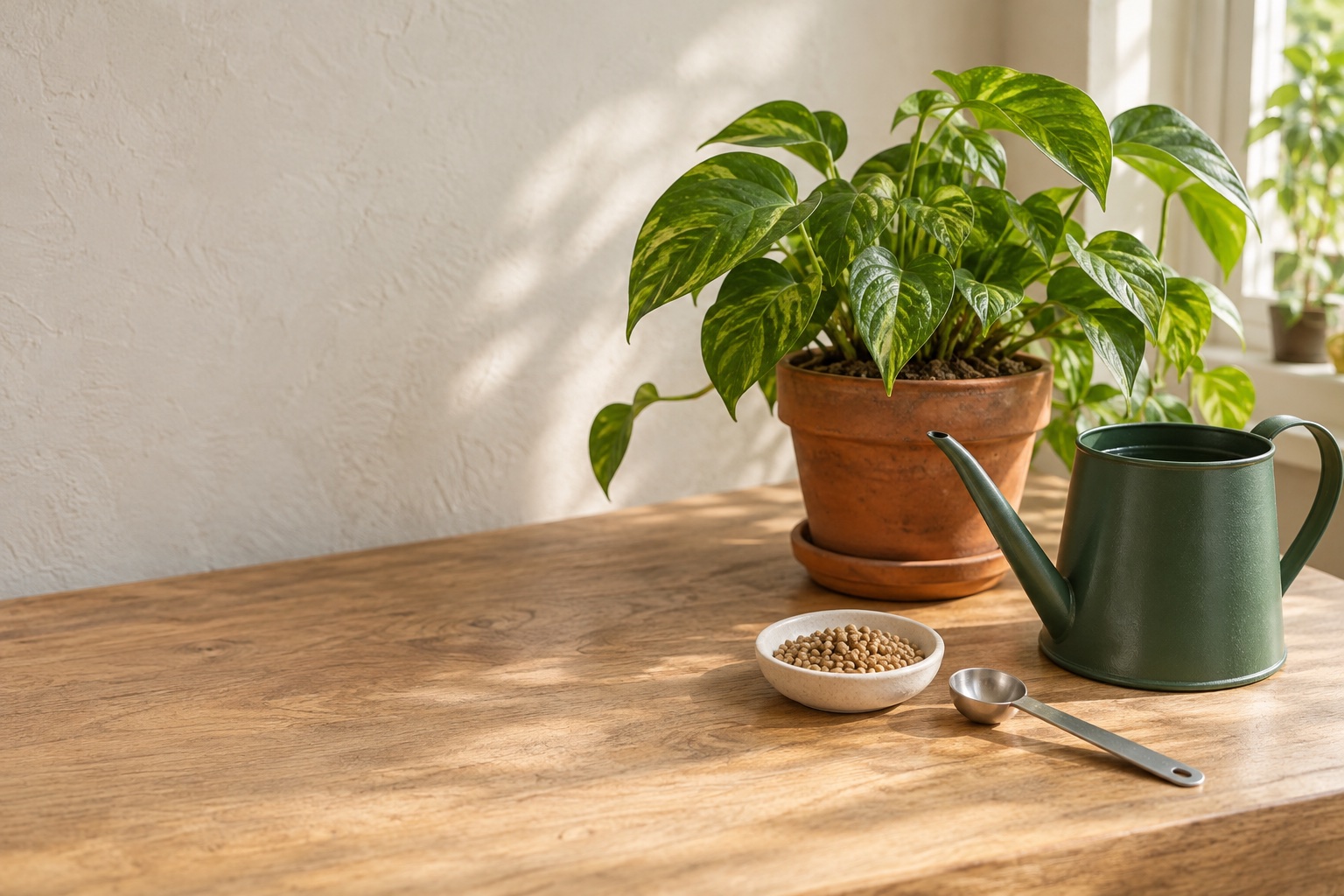
Noot’s directions are one teaspoon in half a gallon of water, used during normal watering and according to the label. Never apply the concentrate directly. That makes the water volume part of the dose: a spoonful in an unmeasured small can is not the same dilution.
Noot combines organic inputs, trace minerals and 16 microbial strains. Check the plant finder for your variety. If your pot already contains fertilizer, confirm the combination before layering routines. The plant’s need for water determines when to water; having a mixed can ready does not.
Sources: Noot
Choose for your collection, not a universal winner
For a small collection, set the labels and measuring tools beside each other and rehearse one normal care session. Which routine can you explain clearly to another person? Which one can you record without relying on memory? Those practical answers are more useful than a claim that one format is best for every plant.
If your collection includes several media or care routines, label the pots by what is already being used. Keep exceptions visible so a shared watering day does not turn into a shared, inappropriate dose.
Common questions
Can a potting mix already contain slow-release fertilizer?
Yes. Check the mix label and the plant’s nursery history before adding another feeding program.
Should I choose a product by its bottle size?
Compare the labeled dilution, intended use and usable mixed volume. Container size alone does not tell you the dose for your plants.
Sources & further reading
- Soils and Fertilizers for Master Gardeners: The Florida Gardener’s Guide to Landscape FertilizersUniversity of Florida IFAS Extension
- Noot plant-food directions and product informationNoot